
Companies House has issued a new scam warning for UK businesses. Recently, fraudsters have been sending letters to business owners, claiming to be from Companies House and requesting payment via a QR code.
In this post, we explain how the new scam operates and how to identify a suspicious letter if it arrives at your doorstep.
How the New Scam Operates
When starting a new business in the UK, you must provide a registered office address and a correspondence address (also known as a ‘Service Address’) during the registration process. These addresses are used by government bodies, such as Companies House and HMRC, to send official communications to the company (registered office address) and to each director individually (correspondence address).
Whether you register directly with Companies House or through a company formation agent like HopeTex, you need to provide this information at incorporation.
- What is a Correspondence Address?
- Service Addresses for Company Directors
- Can I Use Your Registered Office Address Service If I Didn’t Form My Company with HopeTex?
These addresses appear on the public register under your company’s details, making them visible to anyone, including scammers. As a result, scammers are accessing these details and sending counterfeit letters to business owners, pretending to be from Companies House.
The scam letters include a payment code and urge recipients to pay £48 within seven days to gain access to Web Filing, the Companies House online filing portal. The letters claim that failure to comply will result in the “suspension of your web filing benefits.”
How to Identify the New Companies House Scam Letter?
Companies House shared an image of the recent scam letter on their Twitter page, which looks like this:
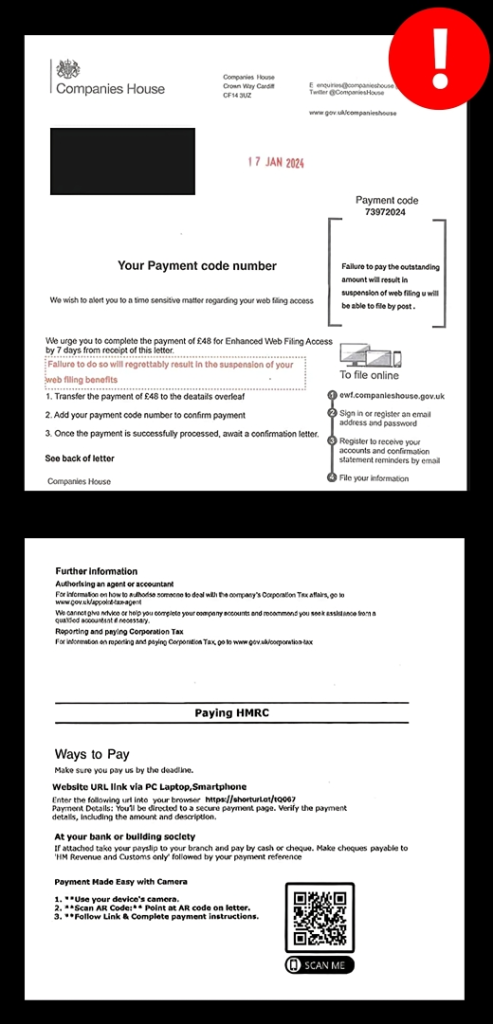
At first glance, it looks quite convincing, and if you don’t look closely, it’s easy to see how some people could be deceived.
There’s a Companies House stamp in the top left corner and contact details in the top right. However, if you examine it closely, that’s essentially all the scammers got (almost) right. Let’s highlight all the red flags in this scam letter.
1.The text isn’t straight
Firstly, the writing on both pages is misaligned, suggesting it has either been scanned or poorly edited.
2.The contact details are incomplete
If you look at the Companies House address and contact details at the top, you’ll notice that the address lacks the Companies House DX number and telephone number, which should be present on genuine Companies House correspondence of this type.
3.The letter is undated
On a genuine Companies House letter, the date is printed in black below your (the recipient’s) name and address. In this scam letter, there is no date, and the date visible in the image above is a stamp from the receiver.
4.Spelling and grammar mistakes
One of the easiest ways to spot a scam is through spelling and grammatical errors. There are plenty in this letter:
- The ‘P’ in ‘Your Payment code number’ should be lowercase.
- ‘web filing’ should be ‘WebFiling’.
- ‘u’ should be ‘you’.
- ‘by 7 days’ should be ‘within 7 days’.
- ‘deatails’ should be ‘details’.
- There’s an unnecessary space after ‘file by post’ in the payment code box.
- ‘url’ should be ‘URL’.
- ‘AR code’ should be ‘QR code’.
There are also some inconsistencies. For example, a full stop appears only at the end of point three on the first page, while the others lack punctuation. Additionally, there is a mix of ‘URL’ and ‘url’ usages.
5.The Second Page Concerns HMRC
Confusingly, the back page requests a Corporation Tax payment to HMRC, while the first page asks for a “web filing” fee to be paid to Companies House.
These two government bodies are entirely separate and would never send you a combined letter like this.
What to Look Out for in Scam Messages?
Whether it’s a letter, text message, email, or call, a payment request is one of the first warning signs of a scam. If you’re being asked to send money—regardless of the amount—proceed with caution.
Next, if it’s a written scam message like this letter, look for any grammatical or spelling mistakes. These errors are usually simple and obvious but serve as a major warning sign.
Finally, if the message creates a sense of urgency and pressures you to make a payment within a short timeframe, it is likely a scam.
What to Do If You Spot a Scam
If you’ve received this scam letter or encountered any other suspicious Companies House correspondence, the Registrar advises that you should not take any action. Do not follow any web links, scan QR codes, or share payment information.
Depending on the type of suspicious communication you receive, report it directly to Companies House. You can report scam letters by calling +447845870007.
If you receive a call, email, or other communication that you suspect is not genuine, follow the Companies House scam reporting guidelines.
Use a Professional Address Service
Hopefully, it doesn’t come to this. To protect yourself and your business, we recommend not using your personal home address as your registered office or service address.
If you don’t have a formal business location and work from home, for example, you can use the address service provided by HopeTex.
- New Rules for Registered Office Addresses – Effective from 4 March 2024.
- 5 Reasons Not to Use Your Home Address as a Registered Office.
- What Is a Registered Office Address?
If you register your company with us, most of our company formation packages include our Registered Office Address Service and Service Address services. This means our Covent Garden address will appear on the public register instead of your residential address. Our experienced Mail Team is trained to identify markings on envelopes from Companies House, which can help reduce the number of scam letters forwarded to you.
If you’re an existing business using your home address and wish to switch to our address, you can purchase our Registered Office Address and Service Address Service without needing to form a new company.
Thank you for reading.
Unfortunately, scams are prevalent and increasingly sophisticated. Stay vigilant and remember to look out for the three main warning signs we highlighted in this post.
Companies House Identity Verification for Directors (UK & Overseas)

A guide to annual accounts

The confirmation statement explained

Do I need to tell Companies House when I move house?

Deadline for filing company accounts – 30 September

Late confirmation statement? Here’s what to do…

The limited company dates that you need to know about

I’ve forgotten my company’s SIC code